Having trouble viewing this email? View it in your web browser

Weekly Water Quality Report

Florida Oceanographic Society provides a snapshot of local water quality conditions in the St. Lucie Estuary (SLE) and southern Indian River Lagoon (IRL) using data collected by our Citizen Science Water Quality Monitoring Program. This report provides an overview of ecosystem health and function for the SLE and IRL and includes a summary of additional water quality conditions from publicly available sources.


Part 1: Florida Oceanographic Society's Water Quality Report

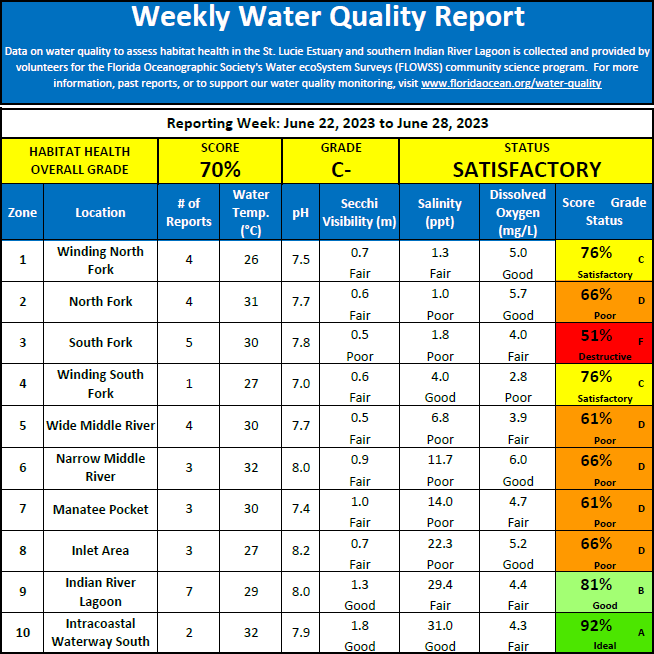
Figure 1. Florida Oceanographic Society's Weekly Water Quality Report for ecosystem health in the SLE and southern IRL. The breakdown is provided by each zone and location for the measured water quality parameter. Grading is based on Secchi visibility, salinity and dissolved oxygen levels. PDF of the full map with information on grading categories.

Disclaimer: The data above indicates changes in water quality parameters to evaluate habitat health. This map is not to be used to indicate current bacteria levels, nutrient levels, or the presence of harmful algae blooms. For up to date information on bacteria levels, visit the Florida Health Beaches Program. For up to date information on nutrients levels, visit ORCA Kilroy or HBOI LOBO. For up to date information about algae blooms, visit the Florida DEP's algae bloom dashboard. 

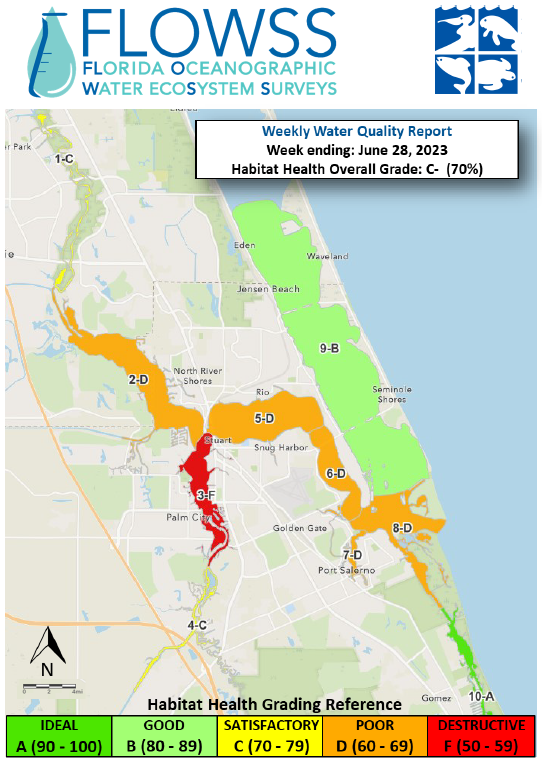
Figure 2. Florida Oceanographic Society's Weekly Water Quality Map for the SLE and southern IRL. Grading is delineated by each zone, represented by both colors and their corresponding letter grade.

Summary of Weekly Water Quality for Habitat Health for Reporting Week

This week’s water quality grade for habitat health in the SLE and southern IRL earned a “C-” based on water clarity, oxygen content, and salinity values in 36 reports across 10 zones.

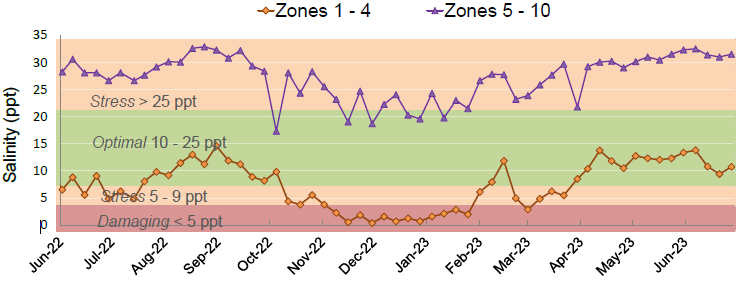
Discharges from Lake Okeechobee stayed at a 0 cfs constant schedule (current Lake Okeechobee daily status, see Table 2). Salinities across the SLE and IRL were poor – good across all zones. Figure 4 shows how these salinities affect oyster habitat health in the IRL.

Water clarity (visibility) was graded as fair – good for seagrass health across all zones within the SLE and IRL. Throughout the SLE and IRL, dissolved oxygen levels were fair – good at all sites.

Disclaimer: The data found on this report is collected by citizen scientists who volunteer their time and effort for the FOS FLOWSS program. Although the data is screened, it comes with no warranties regarding the completeness, accuracy or reliability and is intended for educational and outreach use only. Learn more about the FOS Citizen Science Water Quality Monitoring Program.

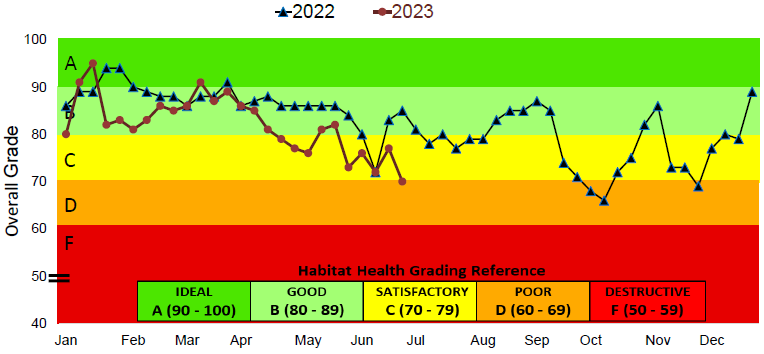
Figure 3. Weekly water quality grades for the SLE and southern IRL for 2022 (blue line) and 2023 (red line). 

Figure 4. Average weekly salinity upstream of the Roosevelt Bridge (Zones 1 – 4) and downstream of the Roosevelt Bridge (Zones 5 – 10). Salinity ratings are based on RECOVER Northern Estuaries Salinity Envelope Performance Measure of 2020. Find out more about the Florida Oceanographic oyster monitoring program and the Florida Oceanographic seagrass monitoring program.

Part 2: Summary of Water Quality Updates Obtained from Publicly Available Sources

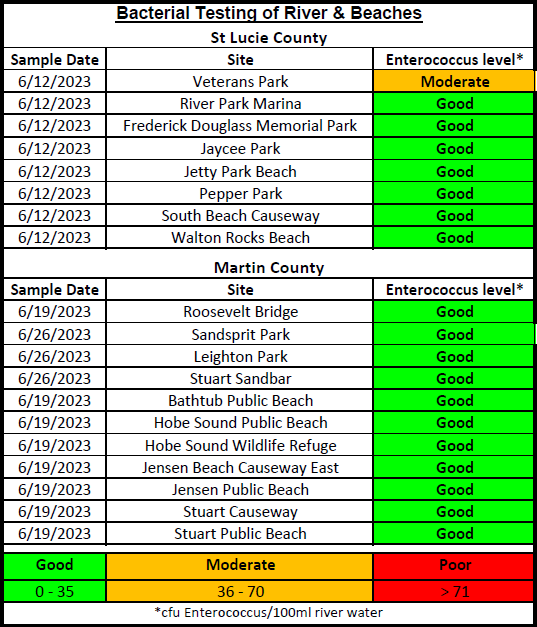
Table 1.  All results were within acceptable levels for enterococcus bacteria. Click for current Martin County and St. Lucie County reports.


FDEP Blue-Green Algal Blooms Report

From the week of June 16, 2023 – June 22, 2023, FDEP reported algal bloom conditions in 45 of 64 samples collected. “The most recent usable satellite imagery for Lake Okeechobee from 6/22 is partially obscured by cloud cover and shows patches of moderate bloom potential, principally in nearshore waters. Satellite imagery from 6/22 for the Caloosahatchee and St. Lucie estuaries shows no bloom potential on visible portions of either estuary.”

For more information on current algal blooms that could potentially affect our Treasure Coast waterways, you can view FDEP's Algal Bloom Sampling Status interactive map at the link below.


SFWMD Weekly Environmental Conditions Reports

Lake Okeechobee: SFWMD reported on June 28, 2023 “Lake Okeechobee stage was 14.52 feet NGVD on June 25, 2023, which is 0.36 feet higher than the previous week and 0.69 feet higher than a month ago. Average daily inflows (excluding rainfall) increased from the previous week, going from 2,417 cfs to 6,631 cfs. Average daily outflows (excluding evapotranspiration) increased from the previous week, going from 0 cfs to 261 cfs. The most recent satellite image (June 25, 2023) showed the highest bloom levels in the central, southern, and northeastern nearshore regions of the Lake. The bloom levels were similar to the previous week and remained medium to high across the Lake.”

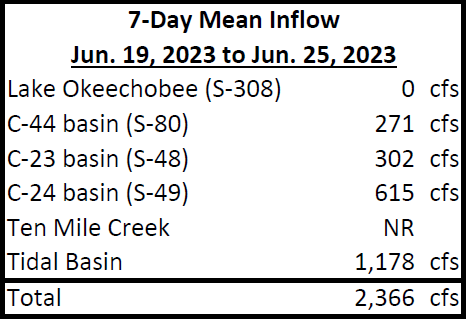
St. Lucie Estuary: SFWMD reported that “Over the past week, mean total inflow to the St. Lucie Estuary was 2,366 cfs, and the previous 30-day mean inflow was 1,432 cfs. Over the past week, salinities decreased at all sites within the estuary. The seven-day moving average of the surface and bottom salinities at the US1 Bridge was 12.0. Salinity conditions in the middle estuary were estimated to be within the optimal range for adult eastern oysters. The mean larval oyster recruitment rate reported by the Fish and Wildlife Research Institute (FWRI) was 0.08 spat/shell for May, which is a decrease from the recruitment rate recorded in April.”


Table 2. Weekly average inflows into the SLE. Data reproduced from the SFWMD Environmental Conditions Report.


Reporting Observations for the Indian River Lagoon

Algal Bloom Monitoring: To report potential blue-green algal blooms, contact FDEP through their online form here or call 800-636-0511. 

Fish Kills Hotline: Please report observations of fish kills or diseased fish to the FWC Fish Kill Hotline through their online form here or call 800-636-0511. You can also download their fish kill reporting app by clicking here. 

IRL Otter Spotter Project: Have you seen a river otter?
Report it here!

IRL Diamondback Terrapin Sightings: Have you seen a diamondback terrapin?
Report it here!

Sawfish Sightings: Have you been lucky enough to spot a sawfish?
Report it here!

Dolphin Spotter: Have you seen a dolphin?
Report it here!

Horseshoe Crab Spotter: Have you seen horseshoe crabs?
Report it here!

Manatee Reporting: To report sick, injured, or dead manatees to FWC call 888-404-FWCC (888-404-3922). 


Water Quality Report compiled by

Florida Oceanographic Society
890 NE Ocean Blvd, Stuart, FL 34996
Website: 
FloridaOcean.org

Questions? Contact our Research Department: 
Email: [email protected]
Office: 772-225-0505 ext. 114

Florida Oceanographic Society's mission is to inspire environmental stewardship of Florida’s coastal ecosystems through education, research and advocacy. 


This weekly report is made possible through the support of our members and generous donors. Please help Florida Oceanographic Society continue our critical monitoring and restoration efforts in local waterways by making a donation or becoming a member today! 


Florida Oceanographic Society
890 Northeast Ocean Blvd.,  | Stuart, Florida  34996
772.225.0505 | [email protected]

Follow Us

Unsubscribe or Manage Your Preferences